iGaming regulation in 2026 continues to reshape the way the industry operates across international GEOs. Brazil has extended its betting ban for another 60 days, while Australia's regulator has introduced additional guidance on digital advertising requirements that will take effect on January 1, 2027.
For advertisers, affiliate networks, and media buying teams, these are more than regulatory headlines. Such decisions directly affect offer availability, advertising channels, partnership terms, and budget planning.
On October 22, we explored the key developments in our article, “Two GEOs Changing the Rules of iGaming: What's Happening in Brazil and Australia?”.
At the time, we examined major restrictions introduced in Brazil's betting market and Australia's preparations for its upcoming advertising reform.
Since then, new decisions have provided a clearer picture of how both regulatory processes are evolving.
In this update, we examine the latest iGaming regulatory developments as of November 12, 2026, and their implications for the affiliate industry.
Brazil: Betting Ban Extended for Another 60 Days
What happened in November?
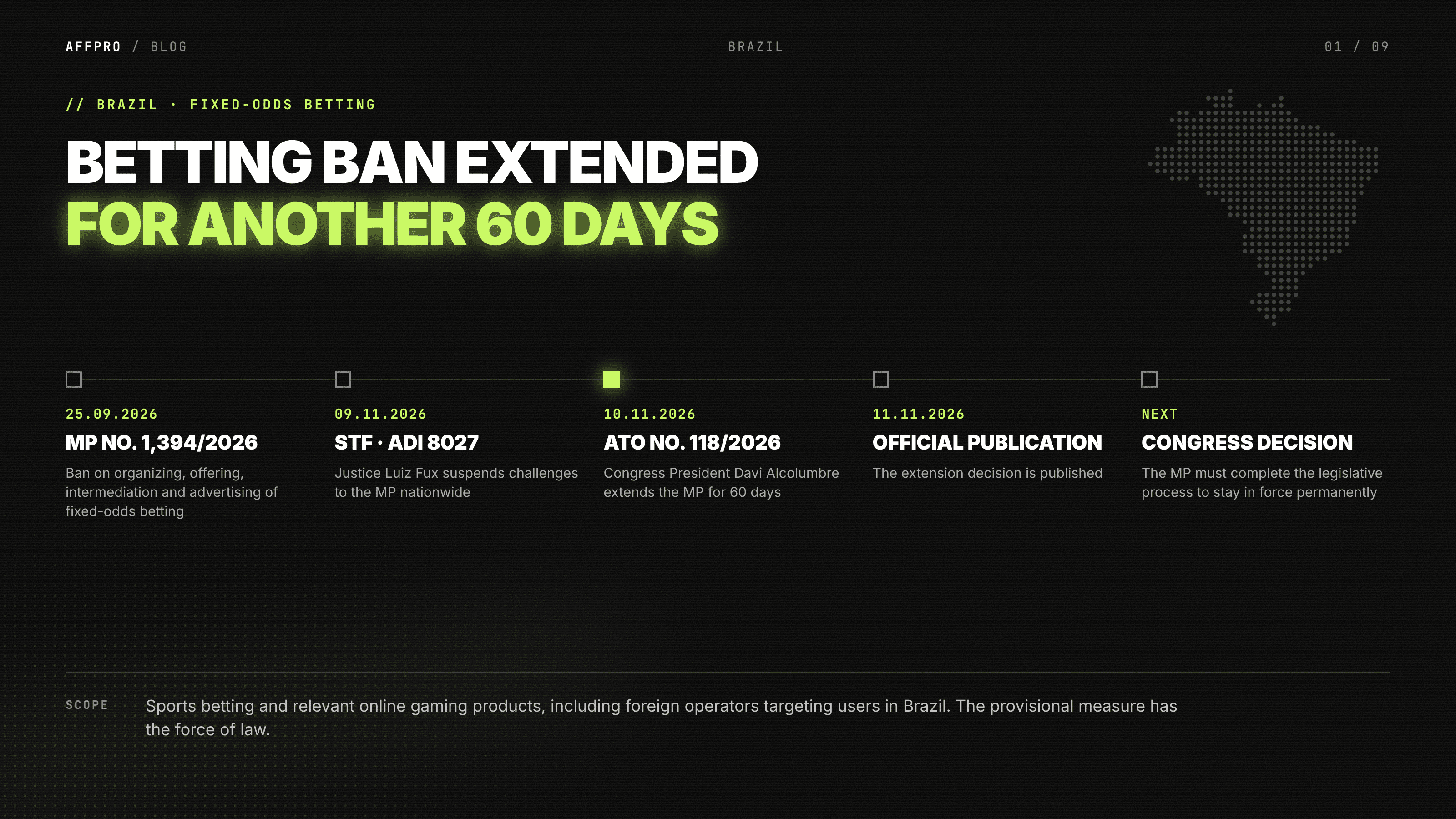
On November 10, 2026, Brazilian Congress President Davi Alcolumbre signed Ato do Presidente da Mesa No. 118/2026, extending the validity of Provisional Measure No. 1,394/2026 for another 60 days.
The decision was officially published on November 11.
As a reminder, Medida Provisória No. 1,394/2026, adopted on September 25, prohibited the organization, offering, intermediation, and advertising of fixed-odds betting in Brazil.
The restrictions apply to sports betting and relevant online gaming products, including offers from foreign operators targeting users in Brazil.
The provisional measure has the force of law. However, for its provisions to remain in effect permanently, the document must complete the legislative process established under Brazilian law.
What does the extension mean?
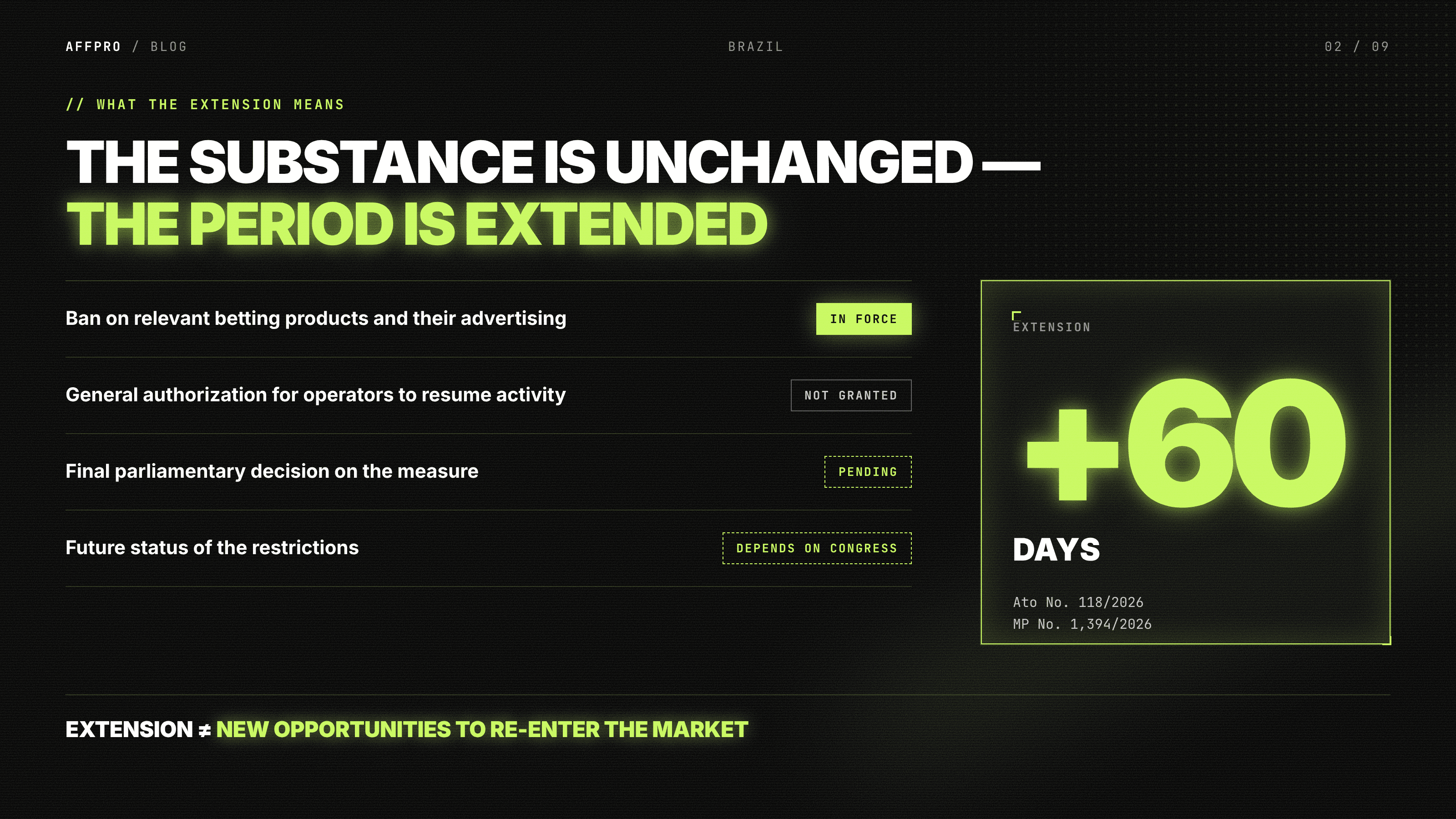
- The ban on relevant betting products and their advertising remains in effect.
- Operators have not received general authorization to resume their activities.
- A final parliamentary decision on the measure has not yet been adopted.
- The future status of the restrictions depends on the outcome of the congressional review.
Therefore, the November decision did not change the substance of the ban but extended the period during which it remains in force.
Official documents:
Medida Provisória No. 1,394/2026 — Full text of the original provisional measure
Ato No. 118 of November 10, 2026 — Official extension decision
Brazilian Congress — Current status and legislative progress of MP No. 1,394/2026
Brazil's Supreme Court Intervenes in Legal Challenges to the Ban
The extension was not the only development affecting betting regulation in Brazil in November.
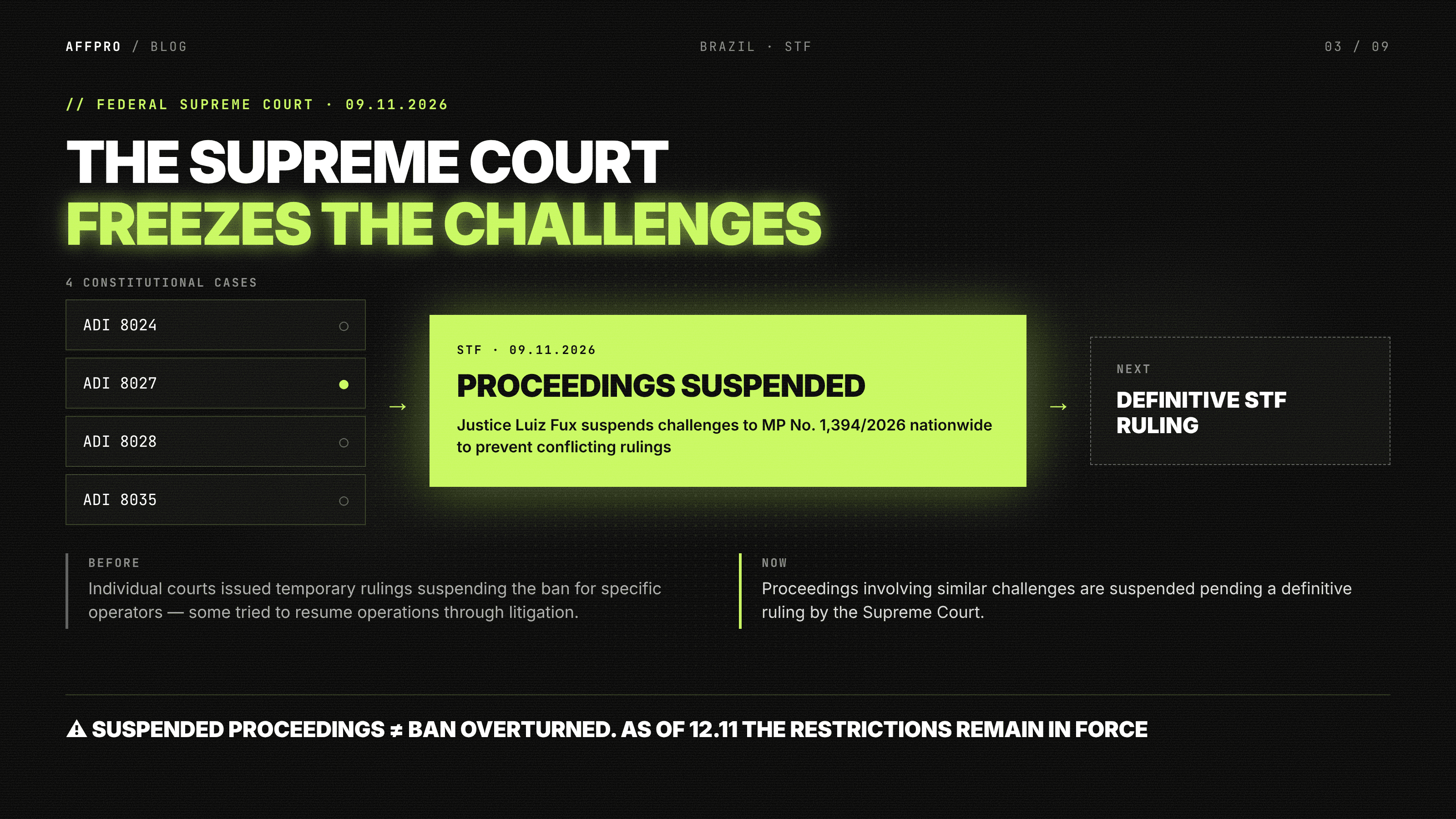
On November 9, Brazil's Federal Supreme Court (STF) announced that Justice Luiz Fux had ordered the suspension of legal proceedings nationwide challenging the constitutionality of Medida Provisória No. 1,394/2026.
The decision was issued in connection with case ADI 8027 following a request from Brazil's Office of the Attorney General.
At that point, the provisional measure was already being challenged in four constitutional cases: ADI 8024, 8027, 8028, and 8035.
The Supreme Court's intervention was intended to prevent conflicting judicial decisions.
Previously, individual courts had issued temporary rulings suspending the application of the ban for specific operators.
This created a situation in which some companies attempted to resume operations through legal proceedings, even though the nationwide legislative ban remained in force.
Proceedings involving similar challenges have now been suspended pending a definitive ruling by the Supreme Court.
Importantly, the suspension of legal proceedings does not mean the betting ban has been overturned. As of November 12, the restrictions remain in effect.
Official source: Supremo Tribunal Federal — Decision of November 9, 2026.
How Does Brazil's Betting Ban Affect Affiliate Marketing?
For the iGaming industry, the extension means that restrictions already affecting advertisers, affiliate networks, and media buying teams will remain in place.
1. An offer's legal status matters more than its technical availability
An active affiliate program or functioning advertising account does not necessarily mean that a product can legally be promoted to users in Brazil.
Before launching a campaign, advertisers and affiliates need to verify applicable restrictions, permitted product categories, and the advertiser's legal status.
2. Regulatory risks extend beyond operators
The legislative restrictions cover the offering, intermediation, and advertising of the relevant betting products.
This means regulatory scrutiny may affect not only operators but also other participants involved in user acquisition.
3. Budget planning requires alternative scenarios
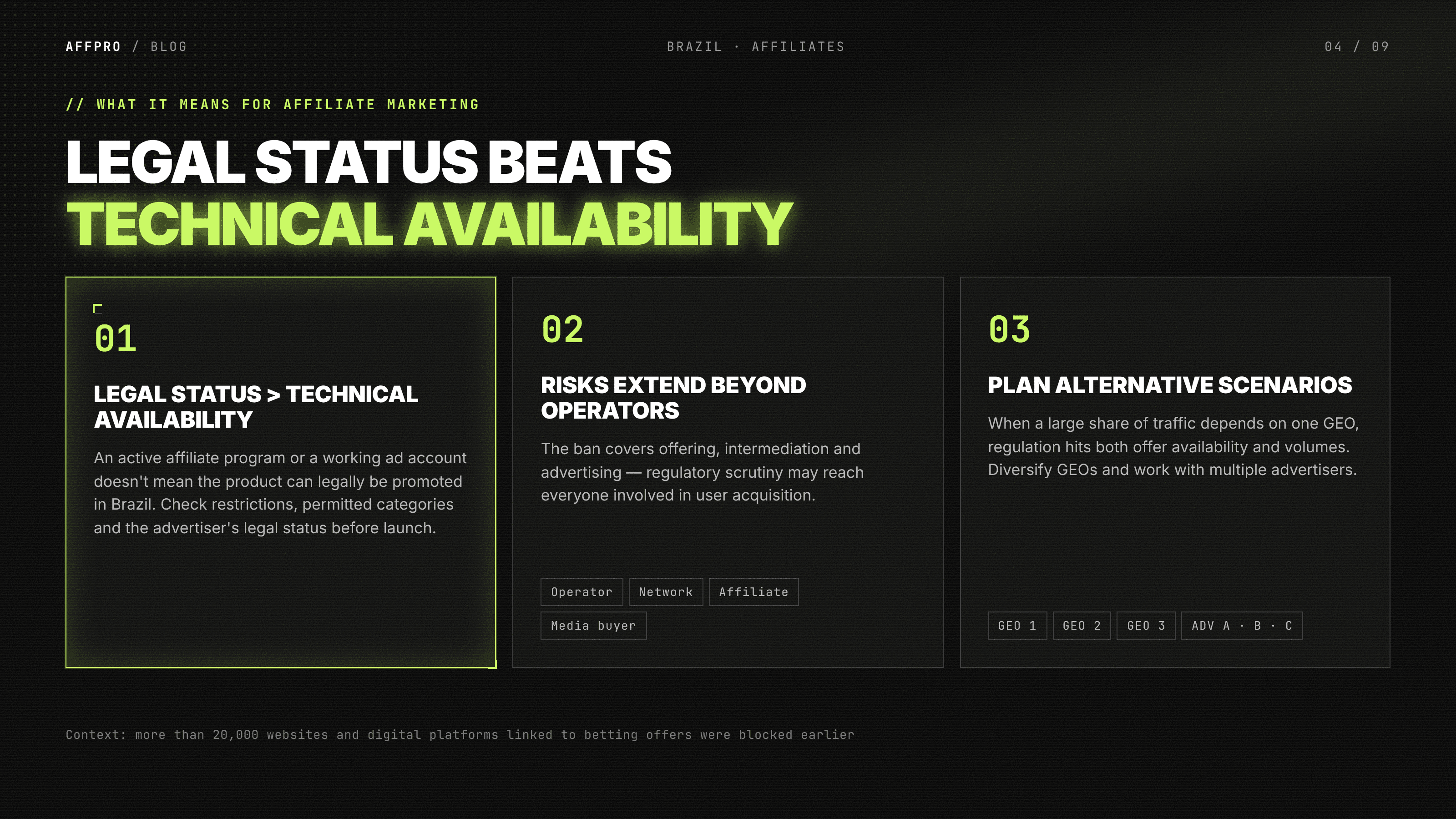
When a significant share of traffic depends on a single GEO, regulatory changes can affect both offer availability and expected traffic volumes.
As a result, GEO diversification and cooperation with multiple advertisers remain important risk management strategies.
We previously examined the broader impact of these developments in AFFPRO's article on iGaming regulation in Brazil and Australia. That analysis also covered the blocking of more than 20,000 websites and digital platforms associated with betting offers and promotion.
The key takeaway for Brazil: extending the ban does not create new opportunities to re-enter the market. Instead, while the measure's final legal status remains unresolved, advertisers and affiliates must continue operating in accordance with the restrictions currently in force.
Australia: ACMA Clarifies New Betting Advertising Rules for 2027
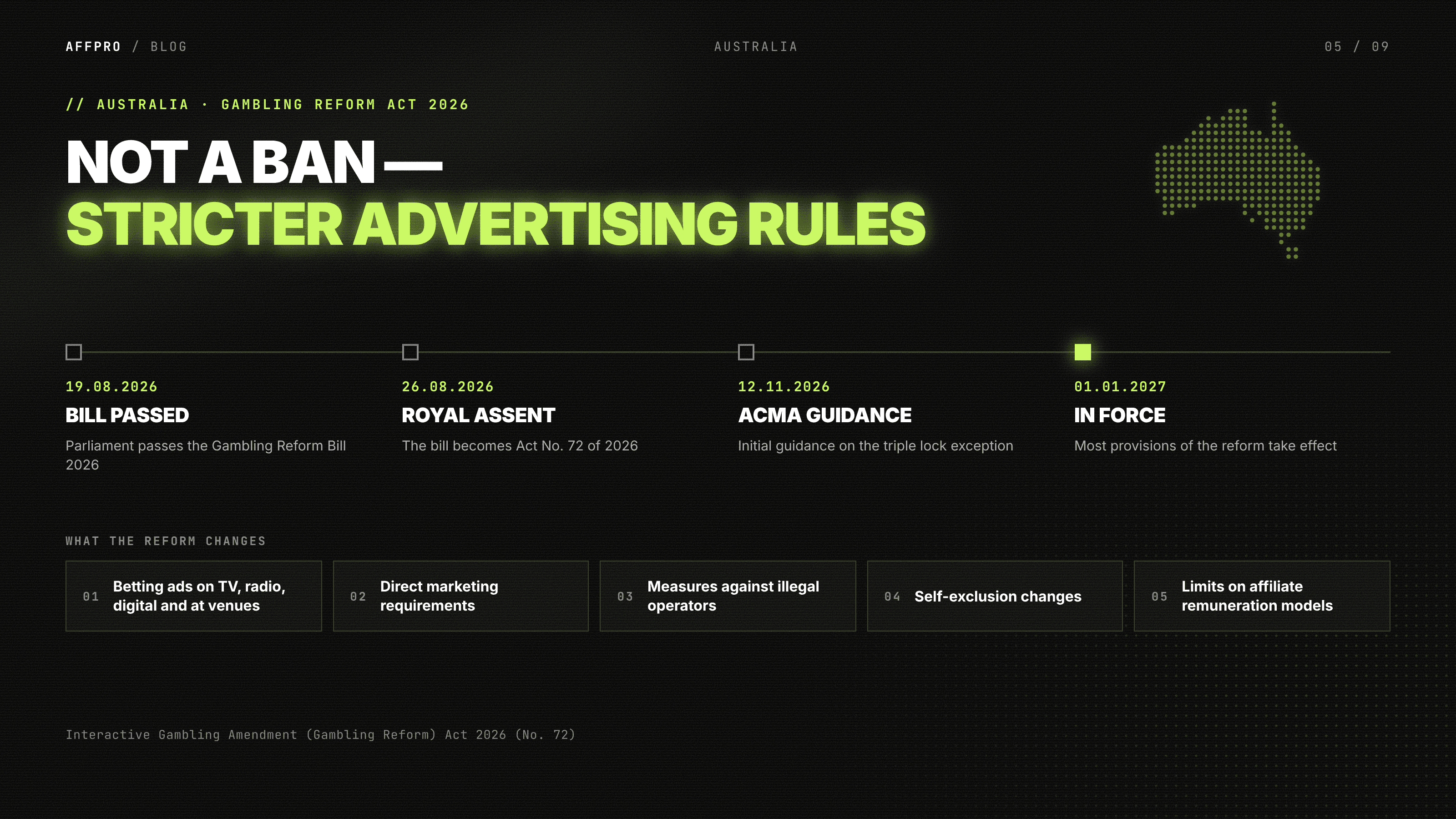
Unlike Brazil, Australia is not introducing a blanket ban on all licensed betting activities. Its reform primarily focuses on tightening the rules governing advertising and promotion.
On August 19, 2026, the Australian Parliament passed the Interactive Gambling Amendment (Gambling Reform) Bill 2026.
The legislation received Royal Assent on August 26 and became the Interactive Gambling Amendment (Gambling Reform) Act 2026 (No. 72).
Most provisions of the reform are scheduled to take effect on January 1, 2027.
The legislation introduces changes in several areas:
- Restrictions on betting advertising across television, radio, digital platforms, and sporting venues.
- Additional requirements for direct marketing.
- Stronger measures targeting illegal operators.
- Changes to consumer self-exclusion mechanisms.
- Restrictions affecting certain affiliate remuneration models.
Official legislation: Interactive Gambling Amendment (Gambling Reform) Act 2026 — Federal Register of Legislation.
Reform overview: Australian Government — Gambling Reforms 2026.
November 12: ACMA Introduces New Guidance. What Is the Triple Lock?
On November 12, 2026, the Australian Communications and Media Authority (ACMA) published initial guidance for digital content providers regarding the triple lock exception.
This mechanism is one of the key elements of Australia's new betting advertising framework.
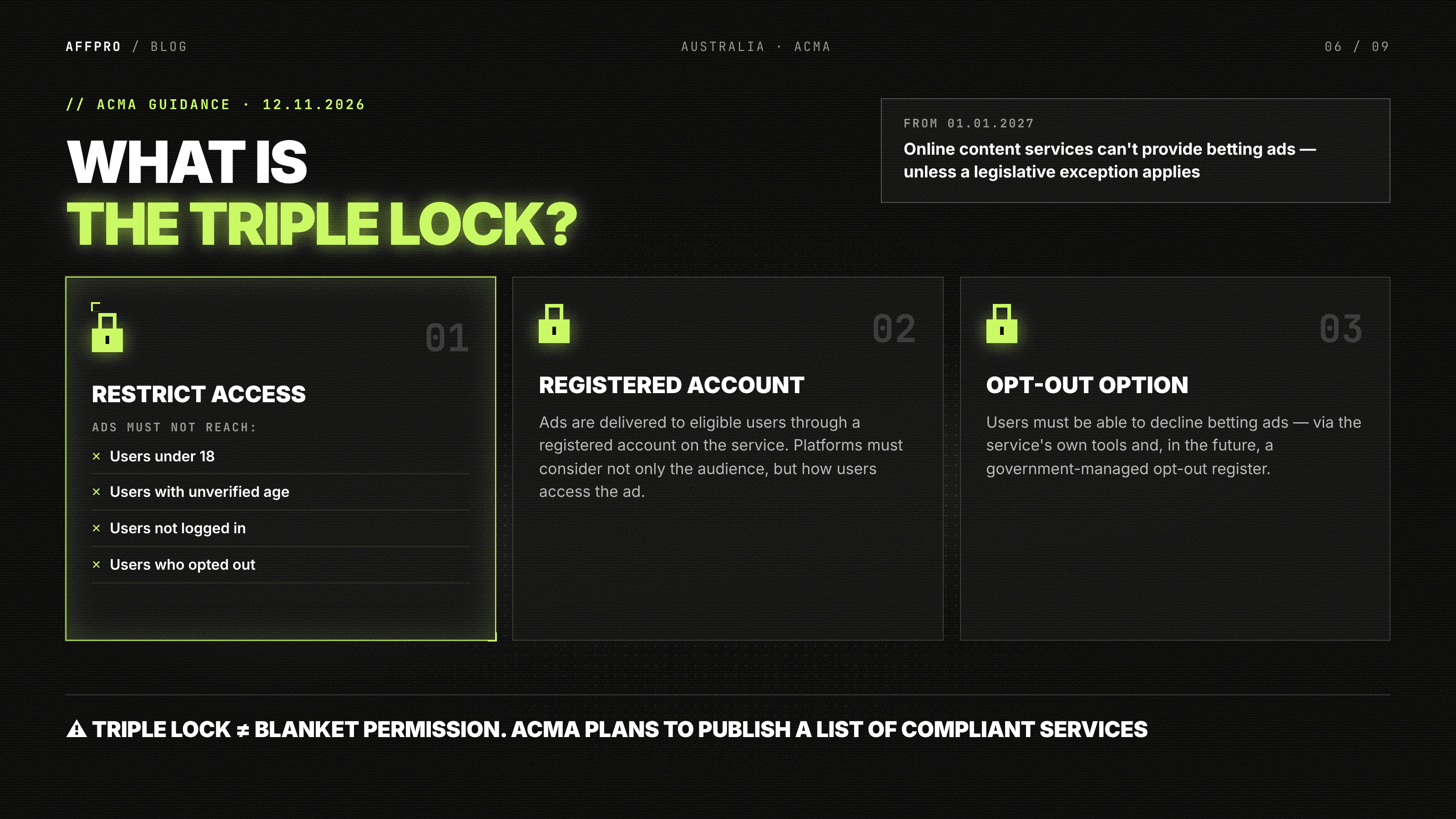
From January 1, 2027, online content services will be prohibited from providing betting-related advertising unless a relevant legislative exception applies.
The triple lock mechanism allows certain online services to display such advertising, provided they take reasonable steps to meet three requirements.
1. Restricting access to advertising
Services must take measures to prevent advertising content from reaching users who are not permitted to receive it.
These categories include:
- Users under the age of 18.
- Users whose age has not been verified.
- Users who are not logged into a registered account.
- Users who have opted out of receiving betting advertising.
2. Registered account access
Advertising must be delivered to eligible users through a registered account on the relevant service.
This means online platforms need to consider not only their campaign audiences but also the conditions under which users access advertising content.
3. Advertising opt-out options
Users must have an option to decline betting-related advertising.
This may involve tools provided by the service itself and, in the future, a relevant government-managed advertising opt-out register.
However, the triple lock does not provide blanket authorization to advertise betting products on any digital platform.
The exception applies only when the conditions established by legislation are met.
ACMA also plans to publish a list of services that have implemented the relevant mechanisms.
Official guidance: ACMA — Triple Lock Exception, November 12, 2026.
What Will Change for Affiliate Marketing in Australia?
Australia's new betting advertising regulations affect several aspects of traffic acquisition and affiliate operations.
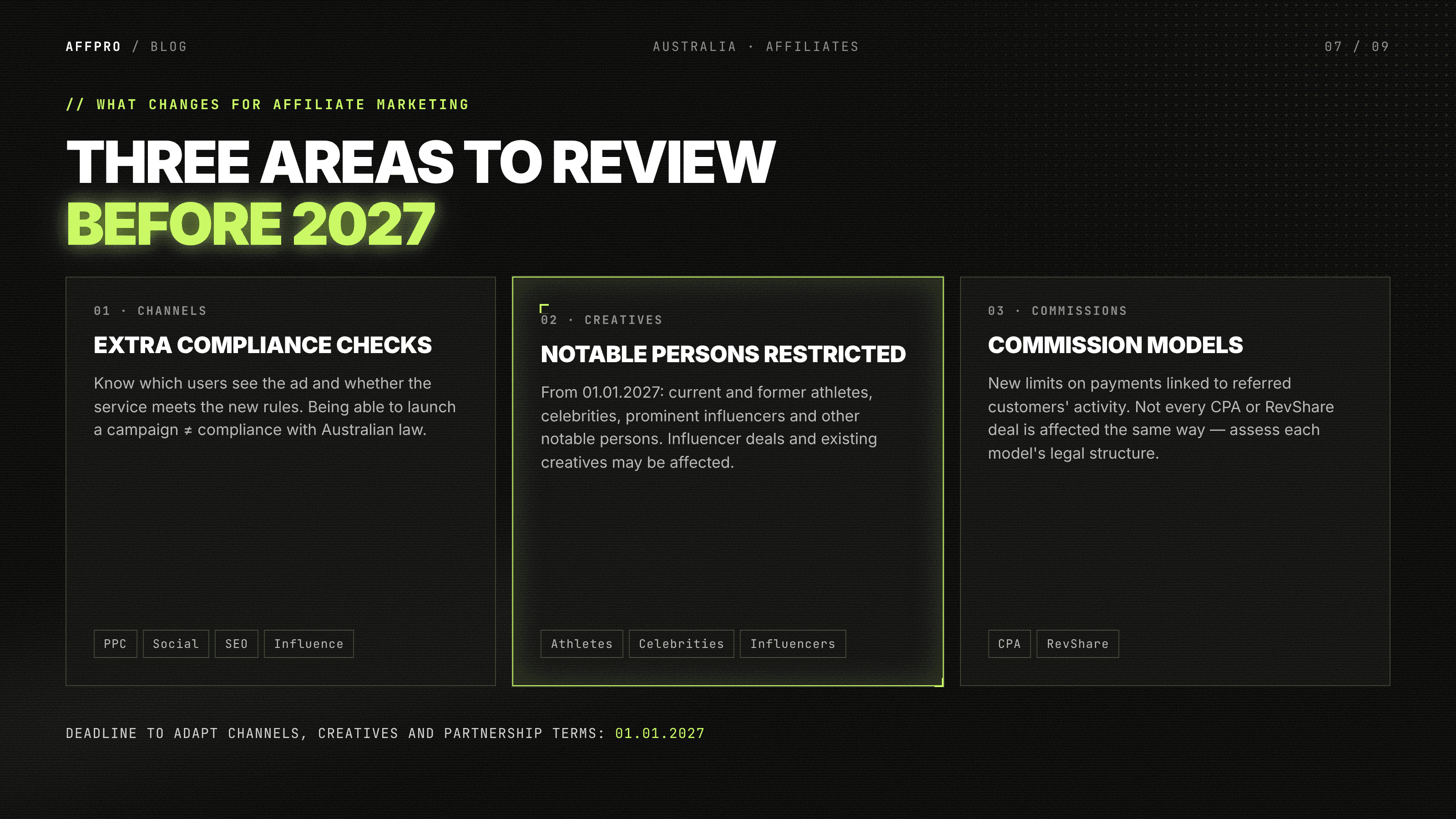
Advertising Channels Will Require Additional Compliance Checks
For advertisers and media buying teams, it will become increasingly important to understand which users are exposed to advertising and whether the online service complies with the new requirements.
The technical ability to launch an advertising campaign does not guarantee compliance with Australian law.
PPC, Social, SEO, Influence, and other traffic sources must be evaluated based on the specific advertising format, product, and applicable legal restrictions.
Advertising Creatives Featuring Well-Known Personalities Will Face Restrictions
Another major component of Australia's gambling advertising reform concerns the use of certain prominent individuals in betting promotions.
From January 1, 2027, restrictions will apply to current and former professional athletes, celebrities, prominent influencers, and other individuals falling within the legislative definition of notable persons.
These requirements may affect influencer marketing, sponsored integrations, and previously developed advertising creatives.
We discussed these restrictions in more detail in AFFPRO's October analysis, “Two GEOs Changing the Rules of iGaming”.
Changes Will Also Affect Affiliate Commission Models
Another important aspect of the reform concerns new restrictions on commission payments linked to the activity of referred customers.
For affiliate networks, advertisers, and affiliates, this may require reviewing certain partnership arrangements.
Particular attention should be given to contractual models in which remuneration is directly linked to customers' subsequent activity.
However, it would be inaccurate to assume that every CPA or RevShare arrangement is automatically subject to identical restrictions.
A proper assessment requires examining the legal structure of individual payment models and the relevant legislative provisions.
Primary legislation: Interactive Gambling Amendment (Gambling Reform) Act 2026 — Schedule 1, Restrictions on Wagering Advertising.
Brazil and Australia: Two Different Approaches to iGaming Regulation
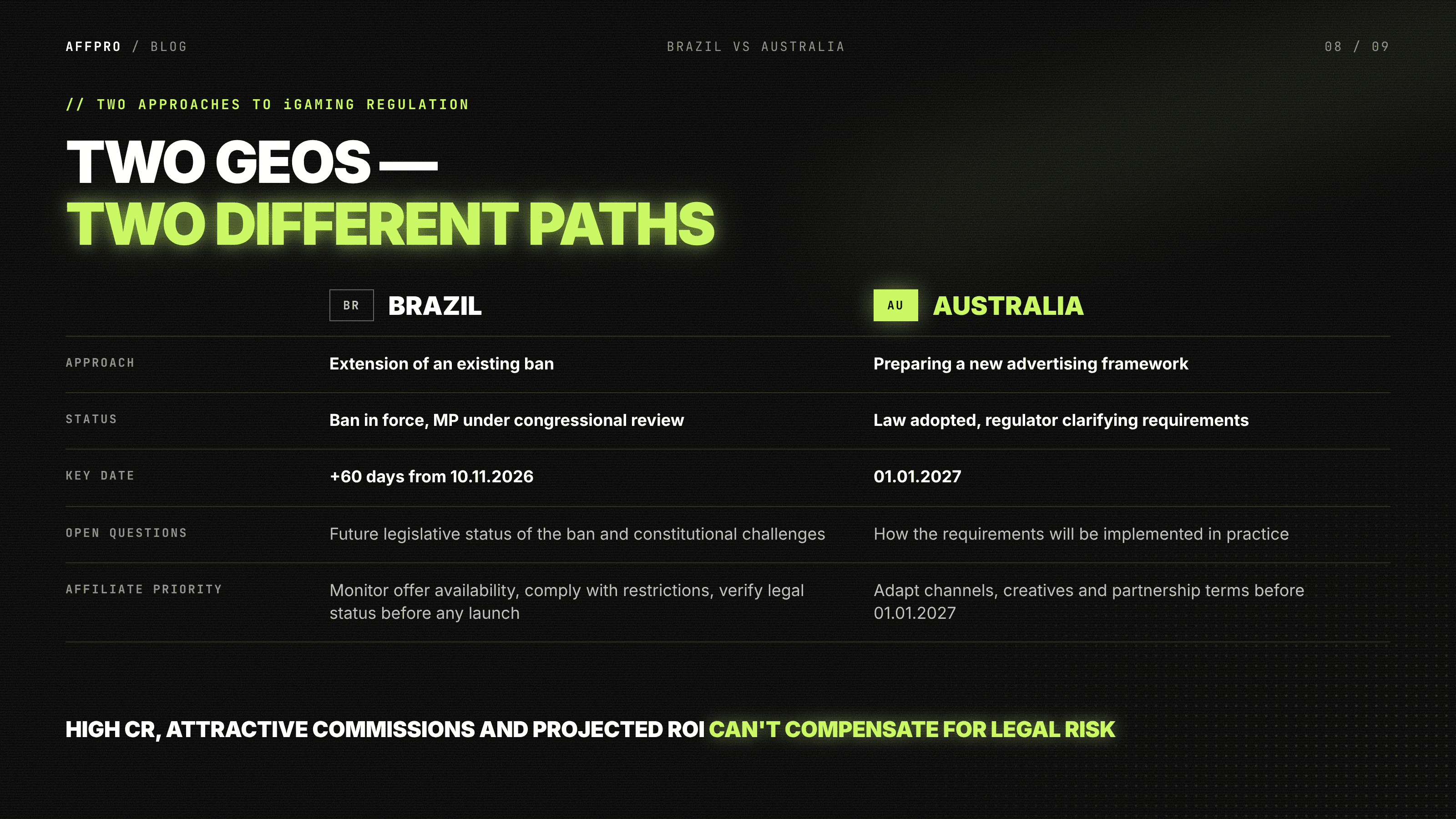
The November developments demonstrate that regulatory changes in iGaming can follow fundamentally different paths.
Brazil — Extension of an Existing Ban
Regulatory measures focus on restricting the offering and promotion of certain betting products.
The main outstanding questions concern the ban's future legislative status and ongoing constitutional challenges.
For the affiliate industry, this means monitoring offer availability, complying with existing restrictions, and avoiding campaign launches without verifying the product's legal status.
Australia — Preparing for a New Advertising Framework
The legislative reform has already been adopted, and the regulator is now clarifying how its requirements should be implemented.
For market participants, the key priority is adapting advertising channels, creative assets, and partnership arrangements before January 1, 2027.
Both scenarios demonstrate that choosing an iGaming GEO requires evaluating regulatory risks alongside commercial performance.
High conversion rates, attractive commission terms, and projected ROI cannot compensate for the legal risks associated with promoting restricted products.
Which Regulatory Developments Should the Industry Monitor Next?
Throughout the remainder of 2026 and into early 2027, several developments deserve particular attention.
Brazil
Further consideration of MP No. 1,394/2026 by Congress and future decisions by the Federal Supreme Court concerning the constitutionality of the measure.
Updates can be monitored through the official Brazilian Congress page for MP No. 1,394/2026.
Australia
Digital platforms' preparation for triple lock compliance, additional regulatory guidance, and the implementation of the main advertising reform provisions on January 1, 2027.
Official updates are available from the Australian Communications and Media Authority.
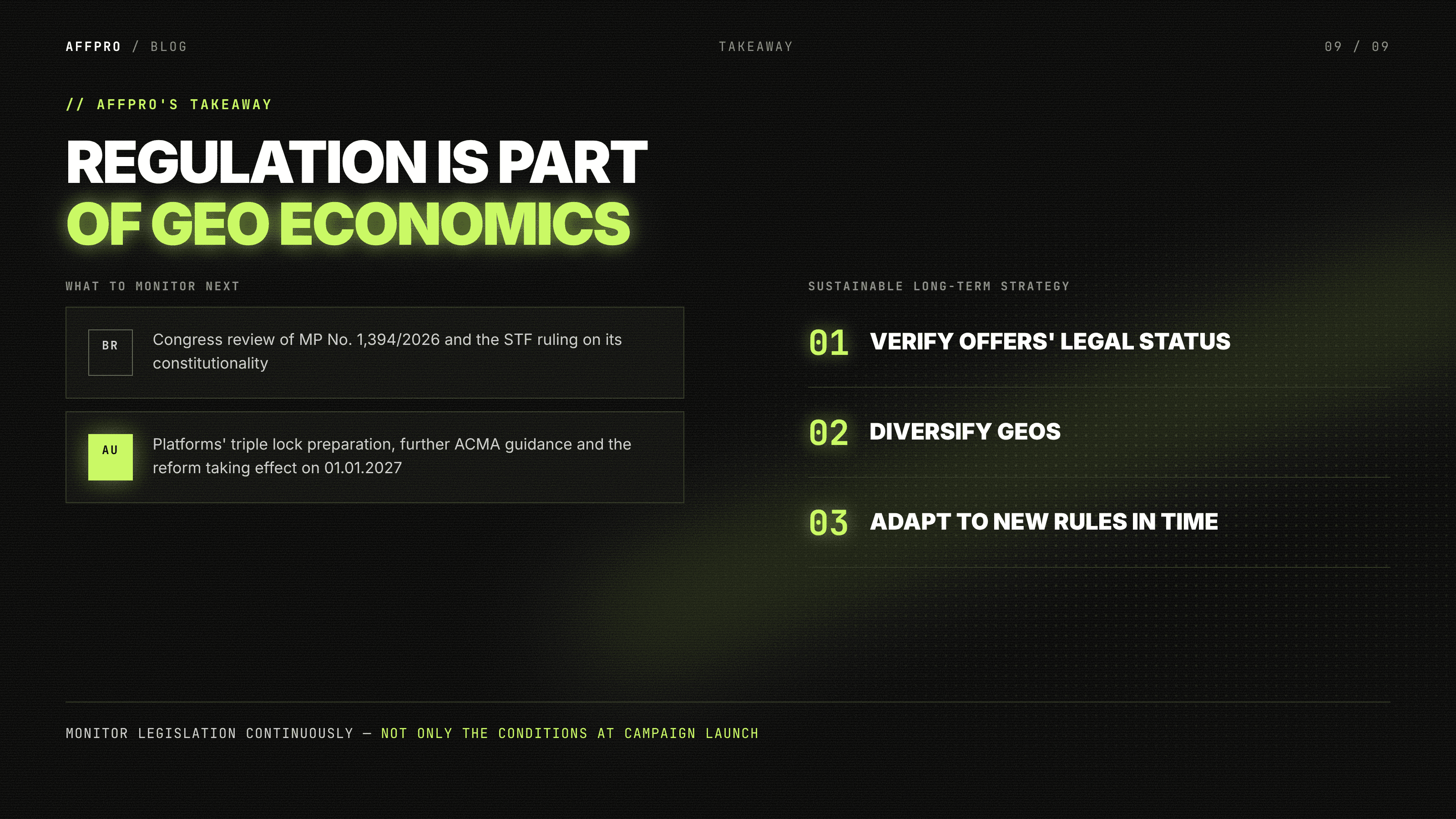
For advertisers and affiliate networks, this means that legislative developments must be monitored continuously rather than relying solely on the conditions that existed when an advertising campaign was launched.
AFFPRO's Takeaway
iGaming regulation in 2026 continues to shape how advertisers, affiliate networks, and media buying teams approach international markets.
Brazil demonstrates how quickly a legislative decision can transform the availability of an entire category of products and advertising opportunities.
Australia illustrates a different scenario: the market continues operating, but the requirements governing promotion, advertising channels, and affiliate arrangements are becoming stricter.
The key takeaway for the affiliate industry is that regulatory conditions within a GEO must be evaluated alongside commercial performance.
Verifying offers' legal status, diversifying GEOs, and adapting to new requirements in a timely manner are becoming essential elements of a sustainable long-term strategy.
At AFFPRO, we continue monitoring legislative changes affecting the iGaming market and traffic acquisition.
Follow our blog for further updates as we examine regulatory decisions and their practical implications for the affiliate industry.