A player searches for one brand, compares several offers, and eventually registers with a completely different operator. In iGaming, this is one of the ways competition for audiences plays out. SEO, comparison websites, affiliate networks, and advertising campaigns can all influence which product a user ultimately chooses. The brand that originally generated the search interest does not always receive the conversion.
In competitive GEOs, operators are not only competing for users who have yet to choose a product.
They also compete for audiences already familiar with specific brands, searching for reviews, checking terms, or comparing alternatives.
The gap between initial interest and actual conversion creates an opportunity for competing offers to enter the customer's decision-making process.
Affiliate websites, search results, paid advertising, and product comparisons may all influence the outcome.
For media buying teams, this highlights a crucial point: brand recognition does not guarantee conversions, and traffic volume does not guarantee approved FTDs.
Let's examine how branded traffic competition works, the differences between mono-brand and cross-brand traffic, and what affiliates should consider before launching campaigns.
Who Really Controls Branded Search Traffic?
Imagine a user sees an operator's advertisement, remembers the brand, but does not register immediately.
Later, the user searches for the brand to review its reputation, payment conditions, or availability in a particular GEO.
However, the results may include more than the operator's official website.
Comparison pages, independent reviews, and competing products may also appear.
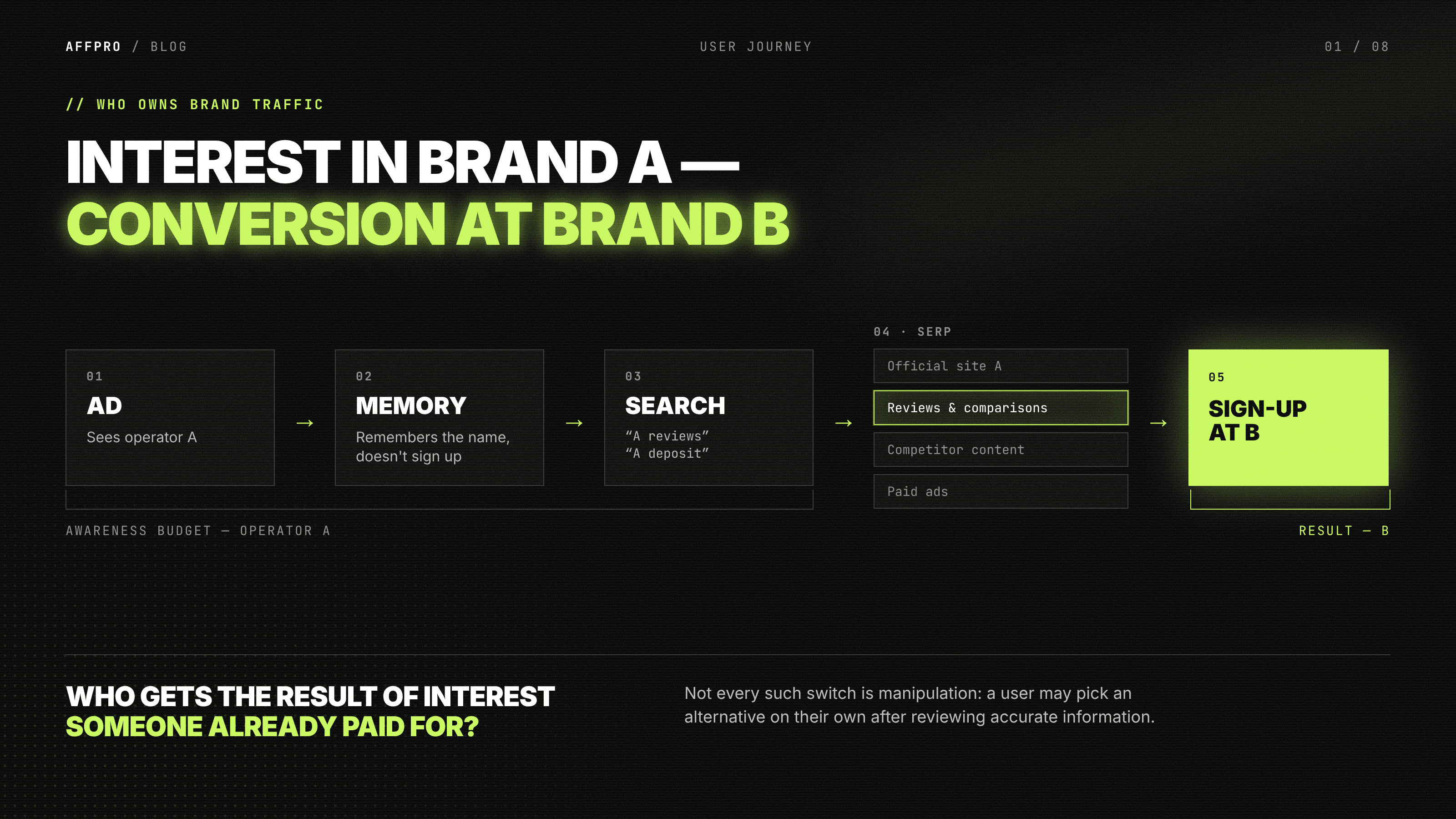
As a result, demand initially associated with one brand can generate a conversion for another.
This does not mean every such conversion involves manipulation. Users may legitimately choose alternatives after reviewing accurate information.
However, it creates an important commercial question for advertisers:
Who ultimately benefits from brand awareness that an operator has already invested significant resources in building?
This is where competition between an operator's direct acquisition channels and affiliate-driven traffic becomes particularly relevant.
Mono-Brand vs. Cross-Brand Traffic: What's the Difference?
In iGaming SEO, two commonly discussed concepts are mono-brand and cross-brand traffic.
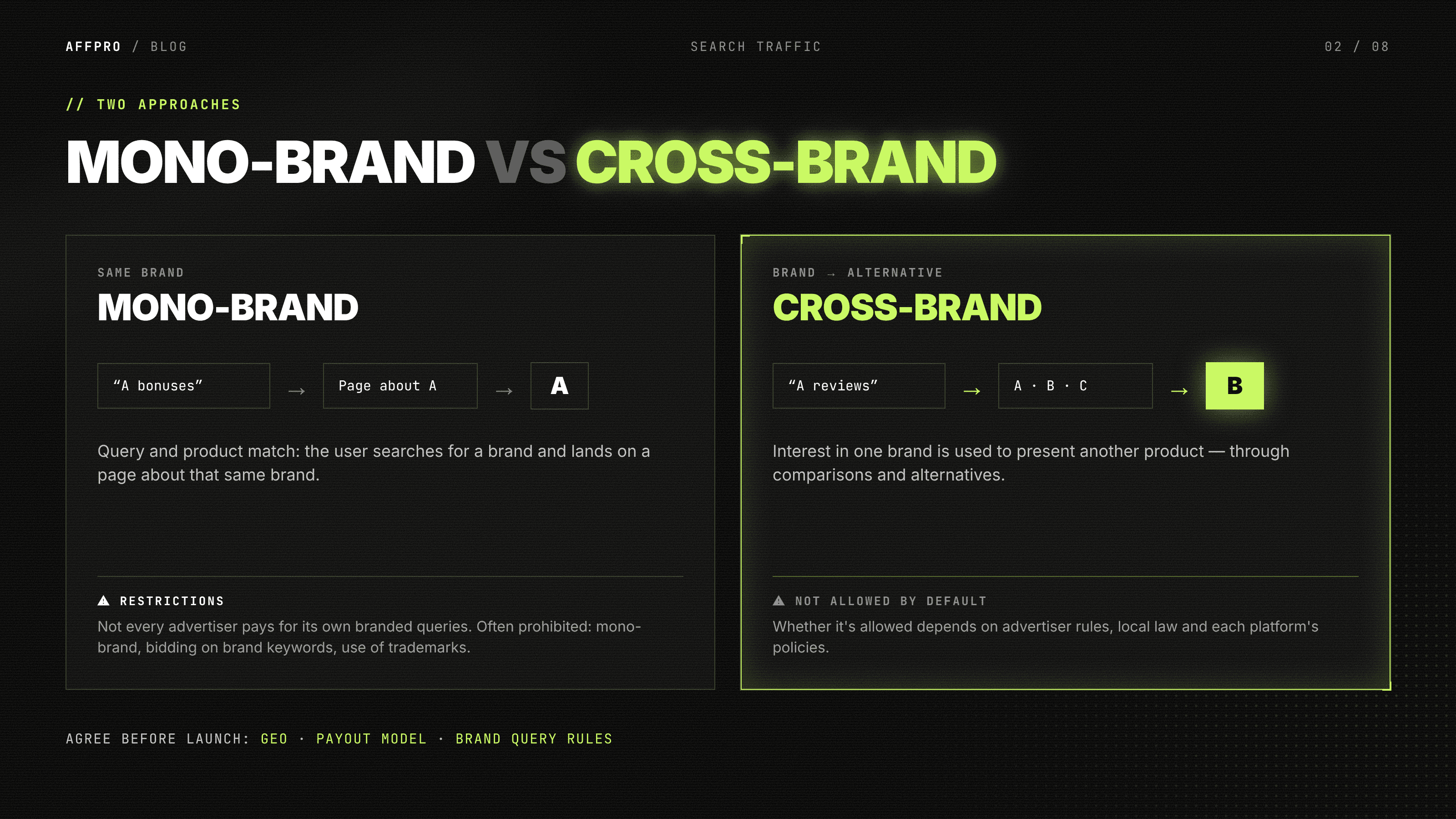
Mono-brand traffic refers to traffic originating from searches related to the same brand being promoted.
For example, someone searches for an operator's name alongside terms such as "reviews," "bonuses," or "official website" and visits a page dedicated to that operator.
Cross-brand traffic involves presenting an alternative product to users originally searching for another brand.
For example, someone searches for operator A, opens a comparison page, reviews the available options, and chooses operator B.
These sources may have different commercial value and are often subject to different affiliate program restrictions.
Not all operators agree to pay affiliates for traffic originating from their own branded search terms.
Some affiliate programs prohibit mono-brand acquisition, bidding on competitors' trademarked keywords, or unauthorized use of brand assets.
Cross-brand traffic is not automatically permitted either.
Its acceptability depends on advertiser terms, applicable legislation, and platform policies.
Before launching, affiliates should therefore clarify not only GEO restrictions and payment models, but also rules governing branded keywords and trademarks.
Comparison Websites: Why Do Users Choose Competing Operators?
Comparison and review websites play an important role in iGaming SEO.
Users often visit these pages after developing an initial interest in a product but before making a final decision.
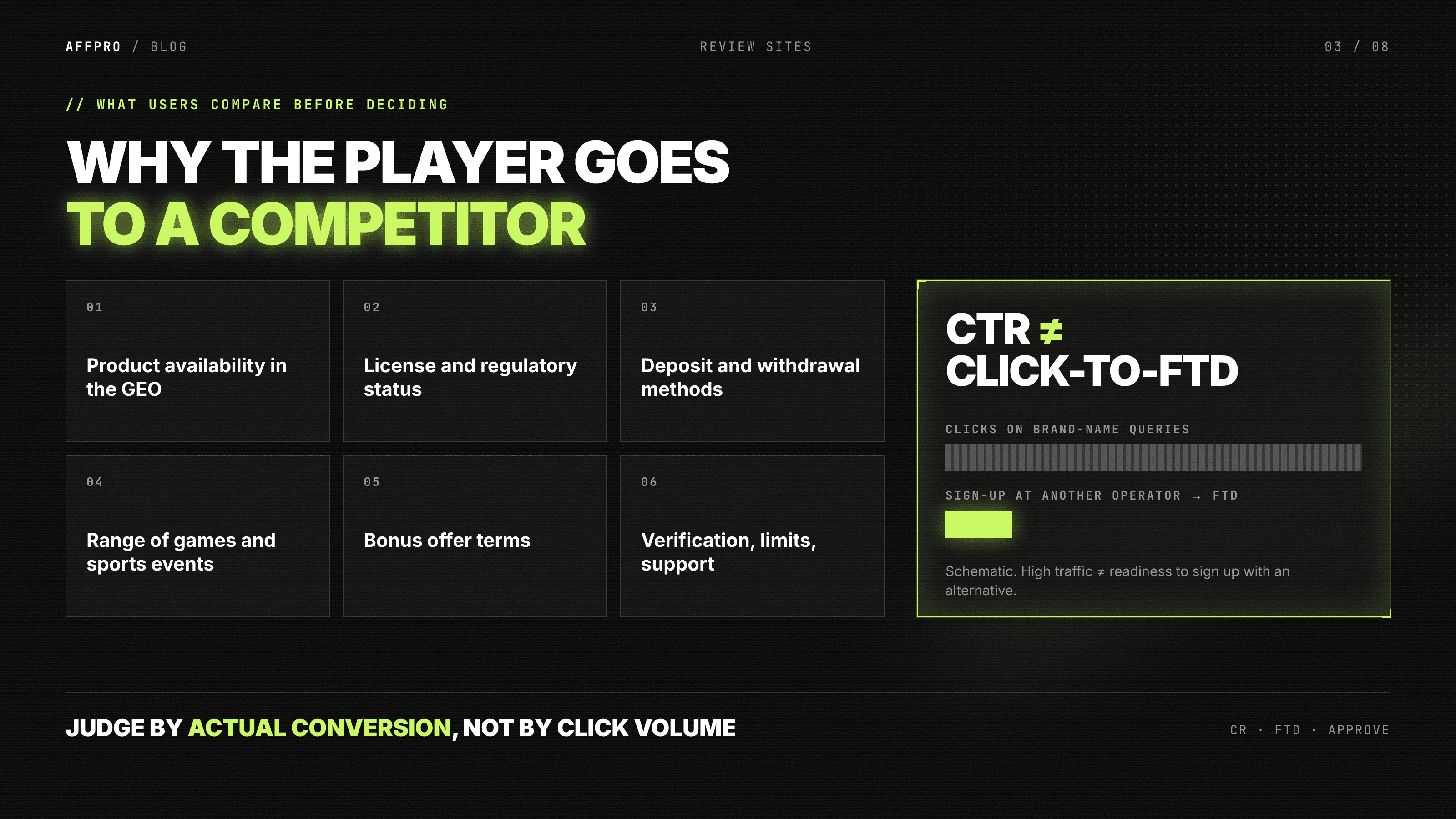
Such websites may compare:
- Product availability within a specific GEO.
- Licensing and regulatory status.
- Deposit and withdrawal methods.
- Available games and sporting events.
- Bonus terms and conditions.
- Verification requirements and customer support.
If an alternative operator better matches the user's needs, that operator may receive the eventual conversion.
For media buyers, the important distinction is between website traffic and qualified acquisition.
A comparison page might attract substantial traffic through searches associated with a popular brand.
However, those visitors may have little interest in registering with another operator.
High CTR does not necessarily translate into strong click-to-FTD conversion rates.
Comparison traffic should therefore be evaluated using conversion performance, approved FTDs, and advertiser requirements rather than click volume alone.
SEO Competition: Where Does Legitimate Comparison Become a Risk?
Competition in search results can involve both helpful independent content and questionable attempts to benefit from another brand's reputation.
Potential risks include lookalike domains, unofficial copies of branded pages, and misleading materials that obscure the identity of the actual operator.
For advertisers, such activity can create brand confusion.
For affiliates, it may result in violations of advertiser terms, search engine policies, or applicable laws.
Google identifies manipulative practices, including site reputation abuse and deceptive redirects, as potential violations of its Search spam policies.
In August 2026, Google also updated its enforcement approach to site reputation abuse within the European Economic Area.
However, publishing affiliate content on an established website is not automatically a violation.
The purpose, quality, and presentation of the content matter.
For compliant SEO strategies, accurate product information, clear brand identification, and transparency should remain essential.
Source: Google Search Central — Spam Policies
Influencers and Advertising Partnerships: Competing for Audience Trust
Search traffic is not the only area where brands compete.
Content creators, streamers, and specialist communities may also influence audience attention in GEOs where the relevant promotion is legally permitted.
One distinguishing feature of influencer-driven traffic is the relationship between the audience and the creator.
Users may respond to a recommendation partly because they trust its source.
When a creator changes advertising partners, some audience attention may move toward the newly promoted product.
However, this does not guarantee that conversion volume will move in the same way.
An audience may trust a creator without being interested in every service they promote.
Advertisers and affiliates should therefore assess confirmed outcomes, traffic relevance, and regulatory compliance alongside reach and engagement.
Comparison Creatives: Why Do Familiar Brands Attract Attention?
Paid advertising sometimes uses side-by-side product comparisons.
A recognizable brand appears alongside an alternative offer, with the creative highlighting differences between them.
This format may attract attention because users recognize one of the products.
However, its effectiveness cannot be measured through CTR alone.
If the comparison misrepresents product terms or creates expectations that the landing page cannot meet, users may be less likely to convert.
Unauthorized trademark usage, misleading claims, and deceptive advertising may also violate platform policies and local regulations.
In iGaming, country-specific gambling advertising restrictions and certification requirements make compliance particularly important.
Comparison advertising should therefore be based on accurate information and permitted formats.
Brand Reputation as a Conversion Factor
Another competitive factor is the information users encounter before registration.
Reviews about withdrawals, customer support, verification procedures, and user experiences can affect trust in a product.
However, negative online sentiment does not always accurately reflect service quality.
Complaints may be legitimate, but confusion can also arise when unofficial websites or impersonators are incorrectly associated with the original operator.
For advertisers, this makes reputation monitoring and responding to verified complaints important.
For media buyers, it reinforces the need to assess the underlying product, especially when conversion rates decline without an obvious change in campaign settings.
How Does Branded Traffic Competition Affect Offer Economics?
For media buying teams, commercial performance matters more than the number of visits to a landing page.
Cross-brand and comparison traffic should be evaluated across the full acquisition funnel.
1. Click. A user interacts with an advertisement or a piece of content.
2. Registration. The user creates an account with the chosen operator.
3. FTD. The registered user makes a first-time deposit.
4. Approved FTD. The advertiser validates the conversion and confirms that it qualifies for payment.
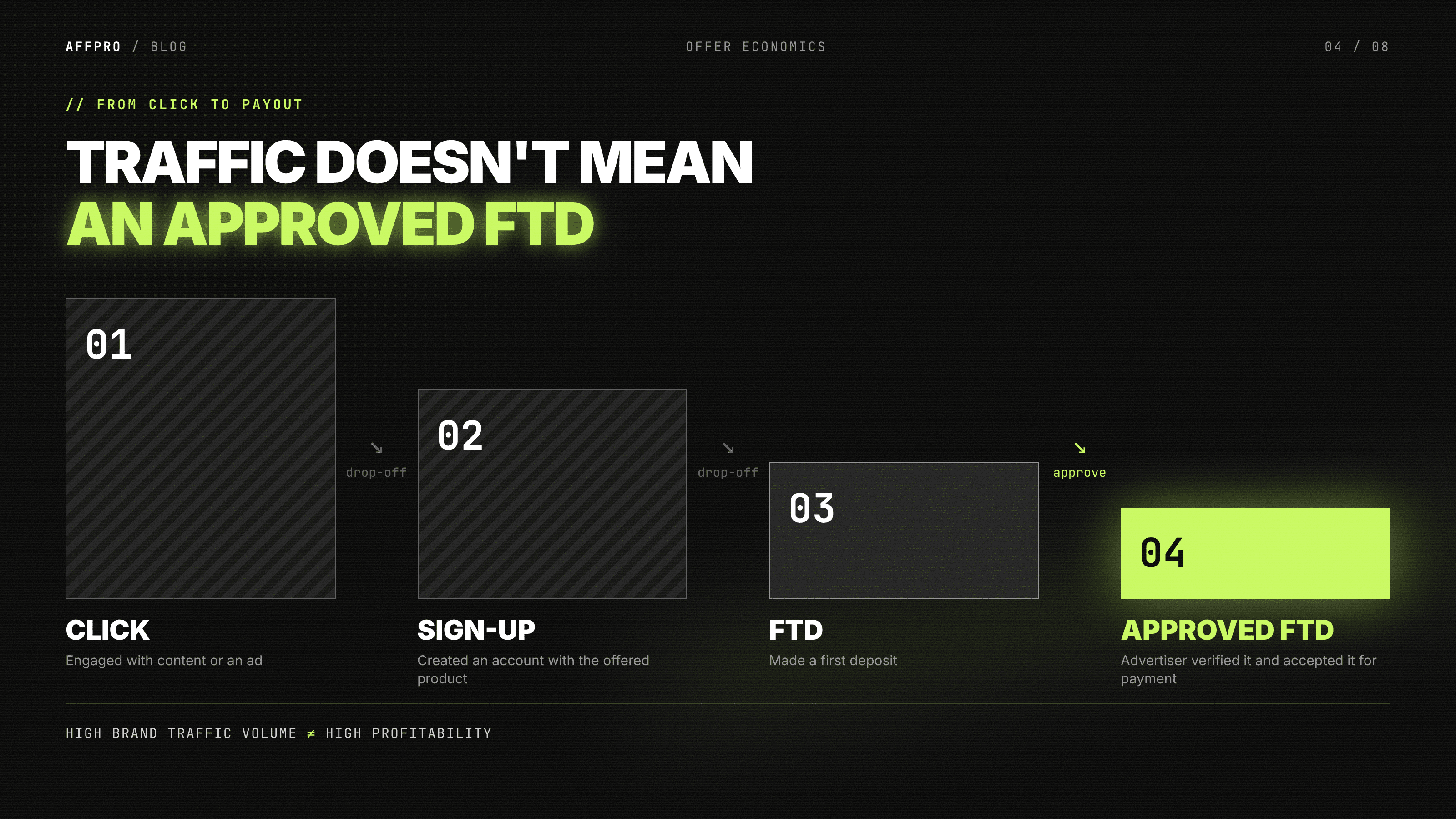
Users may drop out between any of these stages.
This is why high volumes of branded search traffic do not automatically mean high profitability.
Example: Two Offers From the Same Traffic Source
Consider an illustrative scenario in which a team tests two permitted offers using comparable traffic.
Clicks
Offer A - 5,000 | Offer B - 5,000
Click-to-FTD conversion rate
Offer A - 2% | Offer B - 3%
FTDs
Offer A - 100 | Offer B - 150
Approval rate
Offer A - 80% | Offer B - 75%
Expected approved FTDs
Offer A - 80 | Offer B - 112.5
Payout per FTD
Offer A - $110 | Offer B - $85
Expected revenue
Offer A - $8,800 | Offer B - $9,562.50
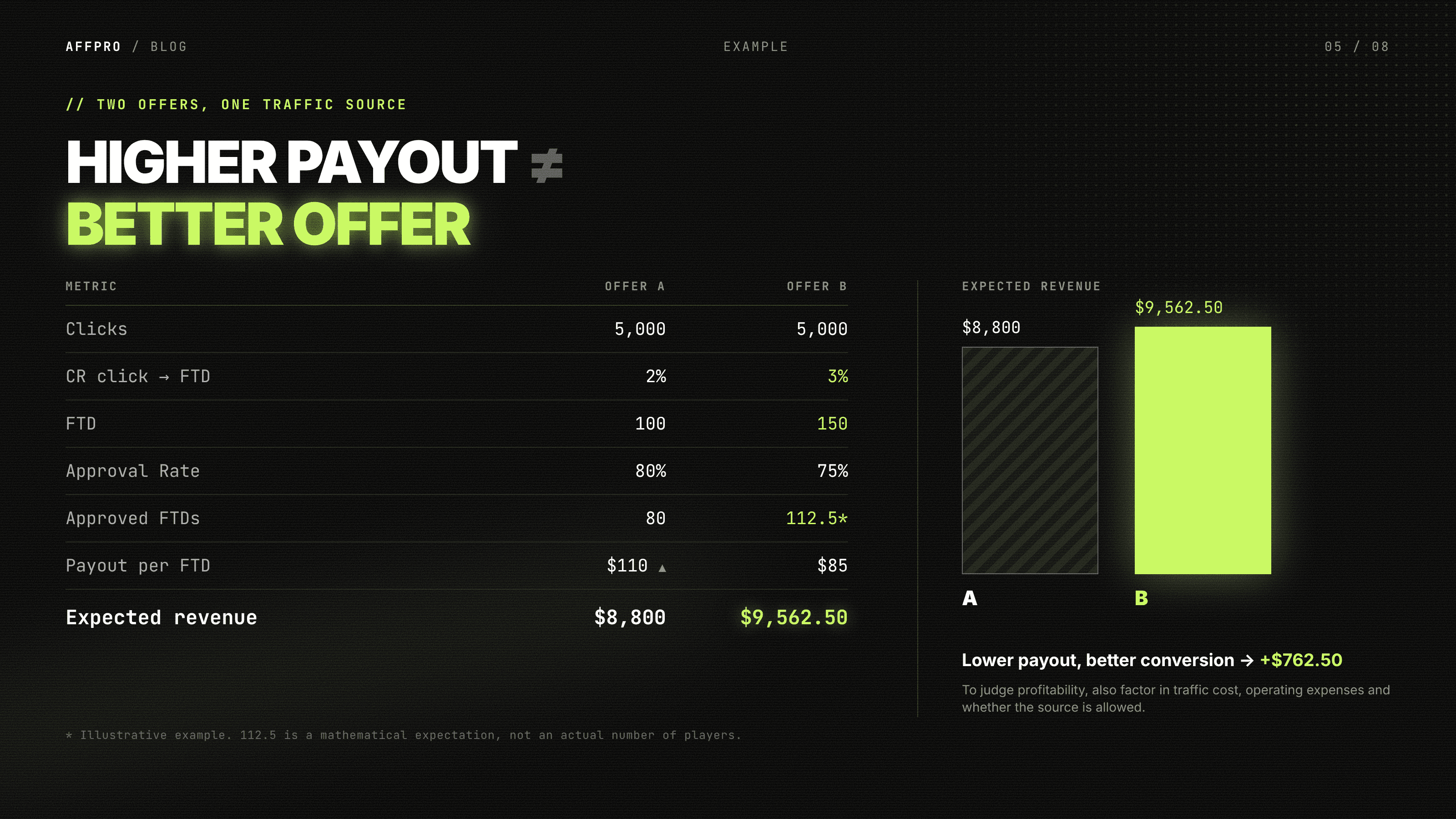
Illustrative example only. Fractional approved FTDs represent an expected statistical value, not an actual count of players.
Despite offering a lower payout per FTD, Offer B may generate more revenue due to its higher conversion rate.
However, actual profitability also depends on acquisition costs, operating expenses, and whether the traffic source complies with the advertiser's terms.
For media buyers, the best offer is not necessarily the one with the highest advertised payout. It is the offer that produces the strongest commercial results for a specific traffic source.
What Should Media Buyers Check Before Launching Branded or Cross-Brand Traffic?
Before launching a campaign, affiliates should clarify the rules for the intended acquisition source.
Situation and Recommended Action
1. Situation: An offer provides a high payout, but the advertiser prohibits branded search traffic.
Recommended action: Avoid prohibited keywords and agree on alternative permitted traffic sources.
2. Situation: A comparison page generates high click volume but low FTD conversion rates.
Recommended action: Review audience relevance, comparison accuracy, and the user's journey to the deposit stage.
3. Situation: FTD volume increases, but approved conversions do not.
Recommended action: Review attribution rules, traffic quality, and rejection reasons with the advertiser.
4. Situation: Unofficial websites with domains similar to an operator's brand appear in search results.
Recommended action: Verify their legitimacy, avoid misleading pages, and notify the advertiser of potential risks.
5. Situation: An advertiser changes its brand or product while an existing partnership uses RevShare.
Recommended action: Agree in advance on how acquired users, attribution, and future revenue-sharing payments will be handled.
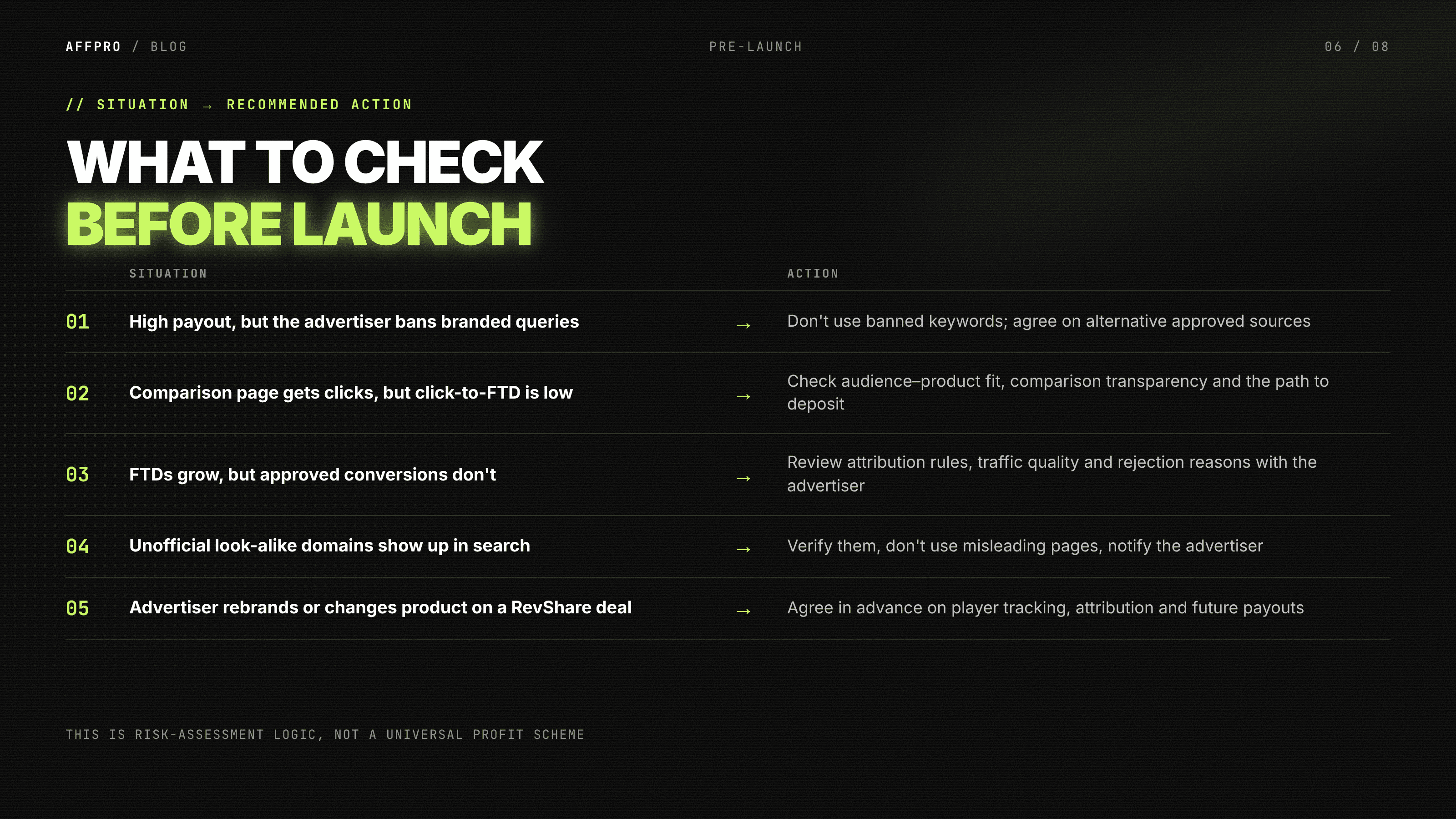
This is a risk assessment framework, not a guaranteed profitability strategy.
What Role Do Affiliate Networks Play in This Competition?
In competitive iGaming markets, an affiliate network provides more than access to offers.
It can also help media buying teams understand which products are suitable for their traffic sources and the conditions under which advertisers will accept conversions.
Particular attention should be given to:
- Whether mono-brand and cross-brand traffic are permitted.
- Rules governing trademark usage.
- GEO and traffic source restrictions.
- Attribution and FTD approval requirements.
- Payment terms following product changes or rebranding.
- The availability of timely advertiser feedback.
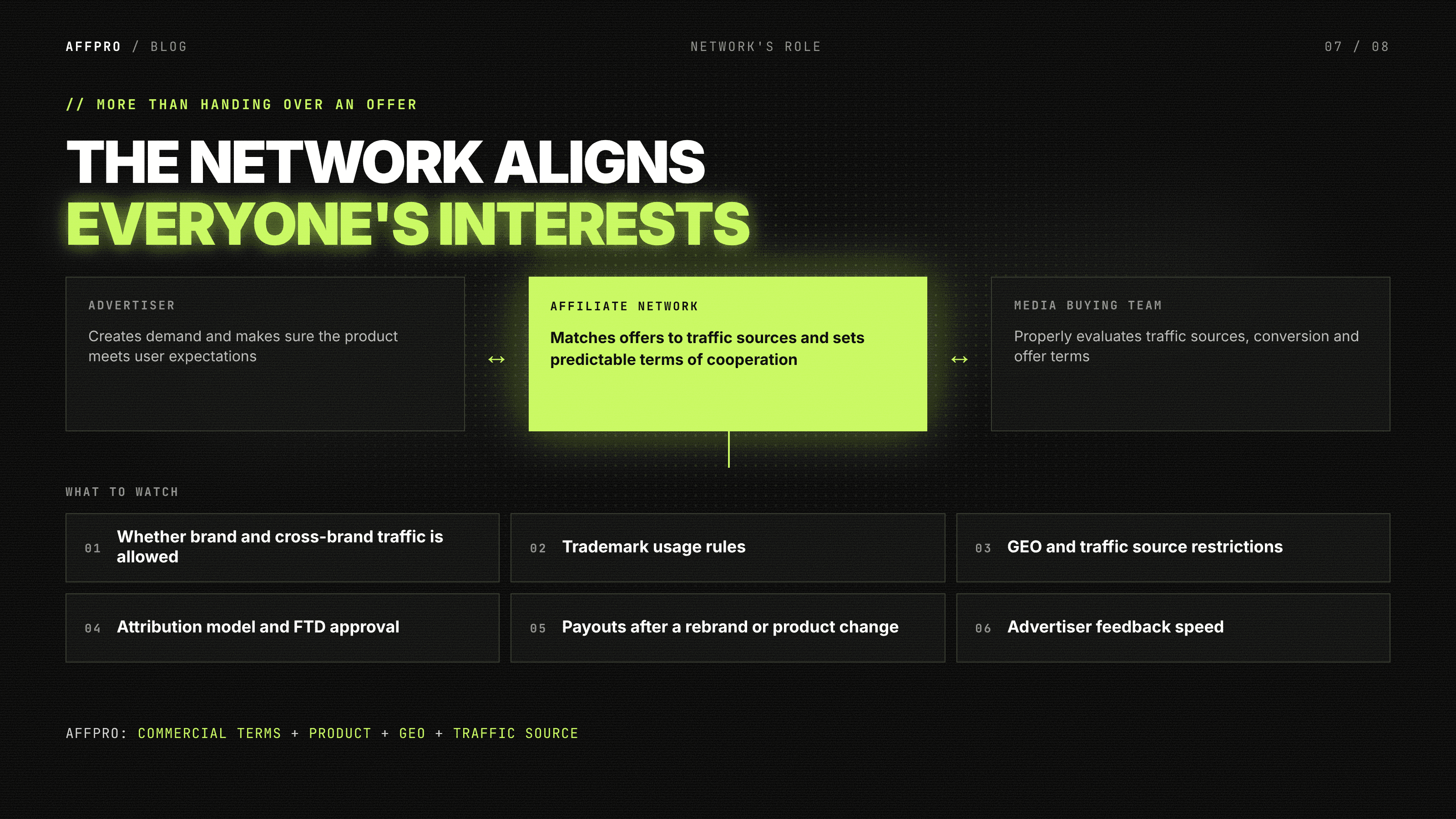
For media buyers, these factors directly affect commercial risk and revenue predictability.
At AFFPRO, we approach offer selection as a combination of commercial terms, product characteristics, GEO requirements, and acquisition sources.
An attractive payout cannot compensate for a campaign that does not meet the advertiser's conditions.
Conclusion: Brand Recognition Does Not Guarantee Conversion Control
Competition between iGaming operators goes well beyond advertising budgets.
Operators may invest in building awareness and generating demand, but the final user decision depends on the information available throughout the acquisition journey.
SEO, comparison websites, advertising partnerships, and affiliate channels all influence this process.
For advertisers, the challenge is not only to generate demand but also to ensure the product matches user expectations.
For media buying teams, the priority is to assess traffic sources, conversion performance, and offer conditions accurately.
For affiliate networks, the role is to align the interests of both sides and support predictable commercial relationships.
In the battle for one player, the largest brand does not necessarily have the advantage. What matters is how effectively the product, traffic source, and affiliate model work together.