
Just a few years ago, the role of an affiliate network was fairly straightforward: find the right offer, connect the advertiser with the affiliate, negotiate the rate, oversee payments, and maintain communication between both sides.
Today, that is no longer enough.
The affiliate market has become faster, more competitive, and more complex. Teams are working with larger budgets, testing more products and GEOs, scaling faster, and changing direction just as quickly when the economics no longer work.
As the market has evolved, so has the role of affiliate networks.
Today, an affiliate network is no longer simply an intermediary between advertisers and traffic. It is a full-fledged business partner that needs to understand the processes on both sides, react quickly to changes, and help find solutions.
01The Intermediary Model Is No Longer Enough
Over the past one to three years, almost everything has changed, but perhaps the biggest transformation has been in how the role of an affiliate network itself is perceived.
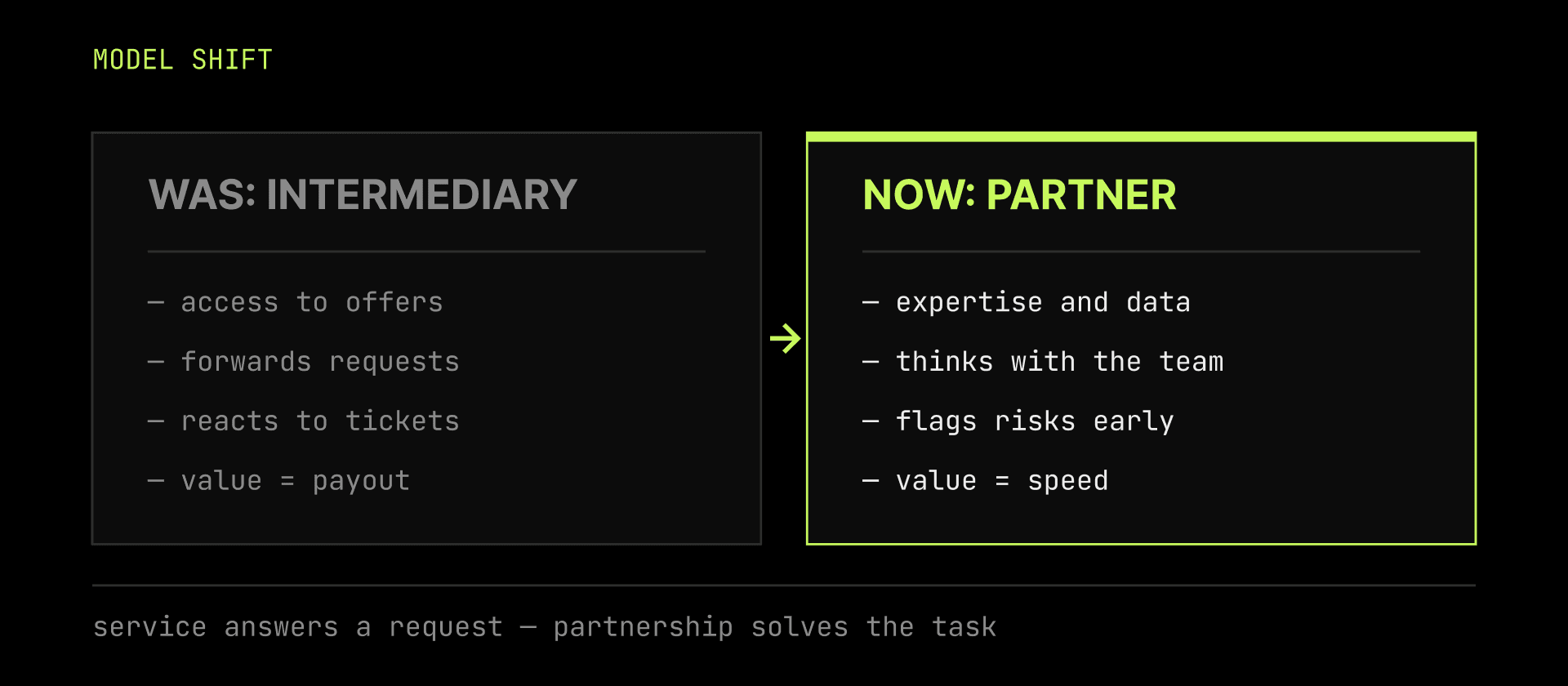
In the past, a network’s main value often came from providing access to offers and facilitating communication with advertisers.
Today, access to a product alone is no longer a sufficient competitive advantage.
Affiliate networks are much more deeply involved in the process. They analyze results, help identify growth opportunities, resolve disputes, test new products together with partners, and look for tailored solutions for individual teams.
The reason is simple: the market moves too fast.
Something that worked consistently six months ago may no longer deliver the required results today. Products change, GEOs change, advertiser requirements evolve, approaches to traffic shift, and user behavior changes.
An affiliate network therefore needs to do more than simply pass information between the two sides. It must stay on top of market developments and adapt quickly alongside its partners.
This shift — from intermediary to partner has become one of the biggest changes in the industry in recent years.
02Why a Good Payout Is No Longer Enough
Payouts still matter. For any team, campaign economics remain one of the key factors when choosing an offer.
But today, a high payout is more of a starting point for the conversation than a guarantee of long-term cooperation.
If an affiliate cannot get quick answers, resolve issues with an advertiser promptly, faces payment delays, or does not feel supported by their manager, sooner or later they will start looking for an alternative.
And very often, they may choose one with a slightly lower payout.
In practice, we have repeatedly seen partners stay with a network specifically because of the level of service. They know that if a problem arises, the team will not disappear or leave them to handle the situation alone — it will work with them to find a solution.
This is particularly important for large media buying teams.
When significant budgets are being spent every day, time directly translates into money. The difference between getting an answer in 15 minutes and waiting two days can mean lost spend, paused campaigns, or a missed opportunity to scale a profitable setup at the right moment.
That is why a strong affiliate manager can sometimes bring more value to a partner than a few extra dollars on the payout.
03Partners Expect Expertise, Not Just Offers
As the market has changed, so have the expectations of affiliates themselves.
In the past, offering a product and agreeing on the terms could be enough. Today, partners expect a much deeper level of involvement.
They want to work with people who understand their business and can provide value even before a campaign launches.
That might mean suggesting a promising GEO. Warning them about changes on the advertiser’s side. Introducing a new product before it becomes widely available. Or helping assess an opportunity based on insights from other launches.
And sometimes, it means being honest enough to say: “It’s better not to launch this offer right now.”
That may sound counterintuitive for a business that earns from volume. But decisions like these are exactly what build long-term relationships.
In affiliate marketing, reputation is not built on a single successful deal. It develops over months and years through the way a company behaves not only when everything is going well, but also when challenges arise.
In those situations, honesty is often more valuable than a short-term opportunity to earn more.
That is why a strong affiliate manager today is no longer simply someone who replies to messages on Telegram.
It is someone who thinks alongside the partner.
04The Manager Becomes Part of the Business Process
This shift is particularly noticeable when working with larger teams.
The higher the traffic volumes, the more interconnected processes need to be managed: caps, payouts, payments, traffic quality, conversions, product changes, new GEOs, and communication with advertisers.
In this environment, the affiliate manager effectively becomes an additional point of support for the team.
Their job is not simply to forward a request to the advertiser and return with an answer.
A strong manager needs to understand why the partner is asking the question, what could happen next, and which solution will work best for both sides.
This is where the line between service and partnership becomes clear. Service responds to a request. Partnership helps solve the underlying problem.
05Technology Will Change Networks — but It Won’t Replace Trust
The next few years will bring even more technology into the affiliate industry.
Automation, real-time analytics, artificial intelligence, faster access to data, and automated recommendations are already becoming part of everyday operations.
And this process will only accelerate.
Many operational tasks that currently take up a manager’s time may gradually become automated. Data will become more accessible, analytics faster, and some decisions more accurate.
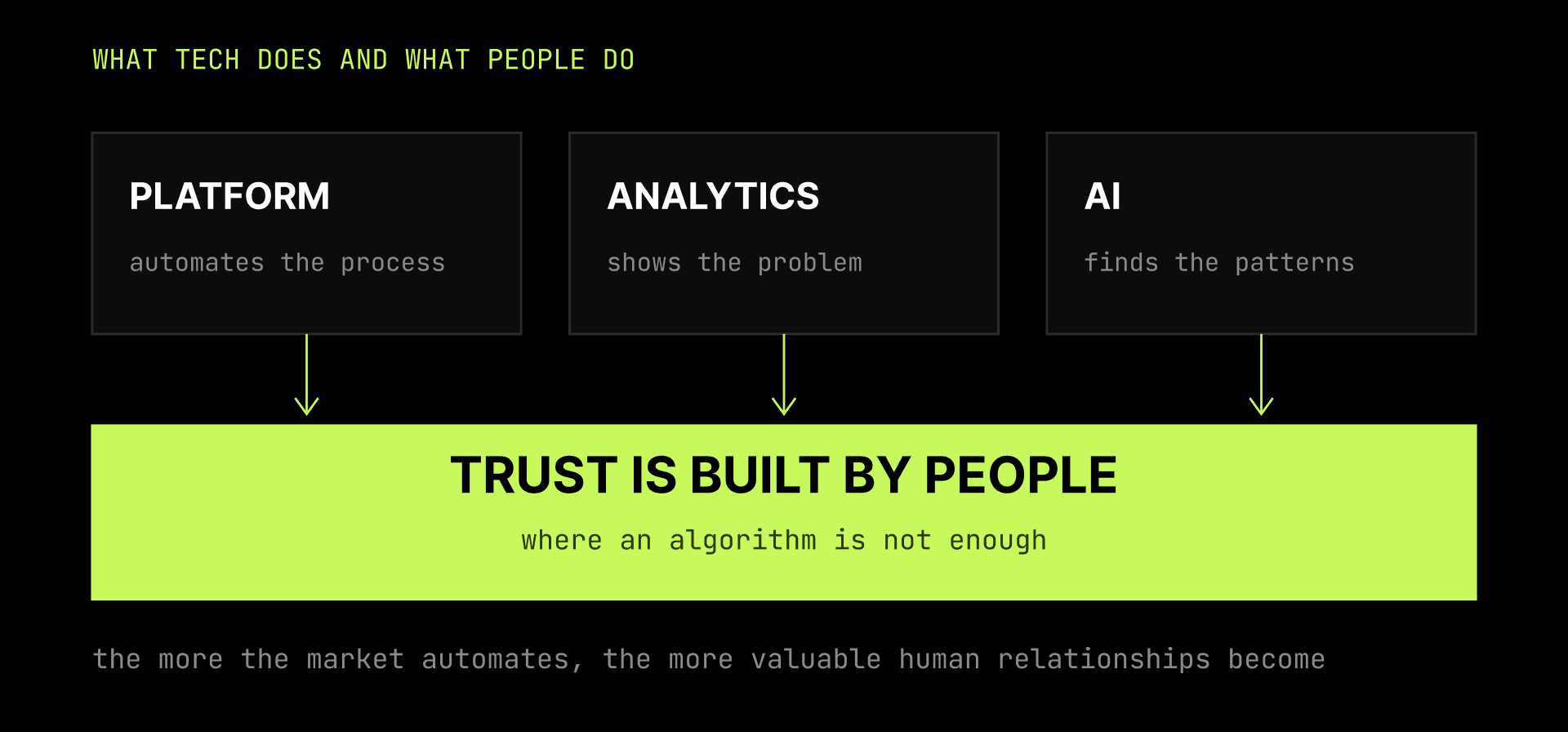
But there is a paradox: the more automated the market becomes, the more valuable human relationships may become.
When it comes to a small test, decisions can often be made based purely on numbers. But when budgets reach tens or hundreds of thousands of dollars, another factor enters the equation – trust.
Can you rely on your partner when a problem arises?
Will they tell you the truth when they see a risk?
Will they defend your team’s interests when dealing with an advertiser?
Can you scale together without worrying that the rules will change at a critical moment?
These are the questions that increasingly influence decisions about long-term partnerships.
06The Future of Affiliate Networks Lies in Combining Technology with Strong Teams
Affiliate networks are unlikely to return to a model where their primary function is simply to connect advertisers with affiliates.
On the contrary, their role will continue to expand.
On one side, the market needs strong technological solutions: automation, transparent statistics, high-quality analytics, and fast access to data. On the other, it needs people who understand the market, partners, and products — and who can make decisions when an algorithm alone is not enough.
That is why I see the future of affiliate networks in the combination of a strong technological foundation and a strong team.
A platform can automate a process. Analytics can identify a problem. AI can help detect patterns faster. But trust between partners is still built by people.
And today, that trust is becoming one of the strongest competitive advantages in affiliate marketing.